
SGWT Advent Calendar: 18th December

Some letters don't soften what war was like. 2nd Lt Wilfred Stanford wrote:

“A shell came along & landed about two or three yards away. The result was the man just in front of me was heard to call out ‘Oh!’ & has never been seen or heard of since.”

This was the terrifying speed with which a human life could vanish. Artillery could obliterate bodies completely. Trenches collapsed. Battlefields were fought over & over again until nothing remained but churned earth.

For families there was no grave to visit, no place to stand, no certainty beyond a name on a casualty list. Memorials to the missing were created to answer that absence. They serve as a substitute for a grave. Names carved into stone at Thiepval, Tyne Cot, Arras & many more.
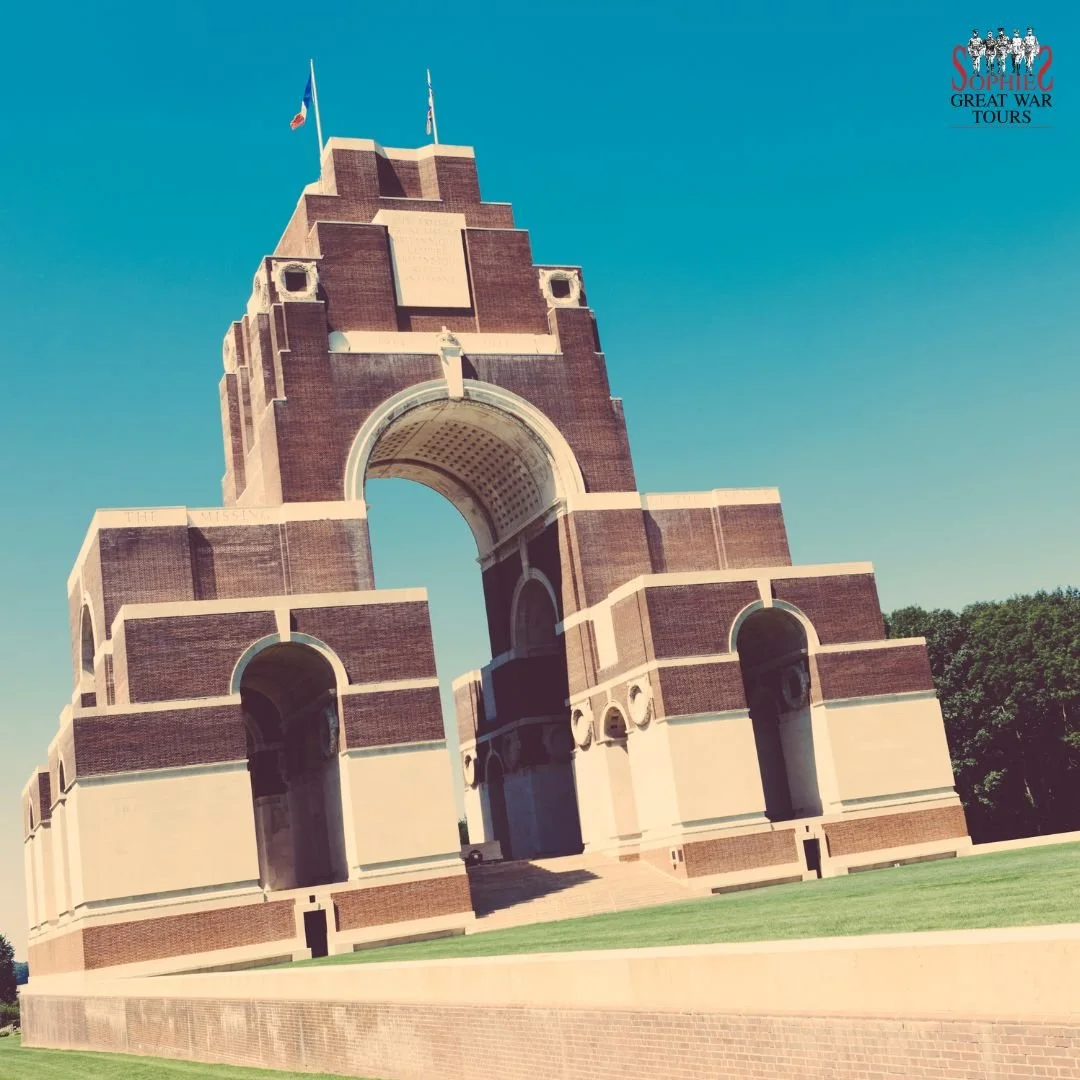
They also speak to the scale of loss. The memorials force us to reckon with how completely war can erase a person from the physical world.

For descendants today, these memorials are often the starting point of discovery. Many families begin their journey with a single name carved into stone & build backwards, service records, battalion movements, battlefield locations.

If you’re searching for someone who never came home, come with me on a bespoke battlefield tour. Let’s uncover their story and stand where they were last known to be. Contact us today.

SGWT Advent Calendar: 17th December 2025

Some letters feel unnervingly modern, like this one from Louis Barthas, a French cooper turned infantryman.

“May the new year bring reason to men.”

It could have been written yesterday.

Barthas wartime notebooks are clear, compassionate, and furious at the waste of life he witnessed. He wrote to record it honestly, the boredom, the fear, the anger, and the longing for a world that might choose sense over slaughter.

If Barthas’ words resonate with you, I’d love to help you explore the French battlefields, places where history still speaks, quietly but insistently, to anyone willing to listen.

SGWT Advent Calendar: 16th December 2025

German soldier Erich Maria Remarque, who went on to write the world famous 'All Quiet on the Western Front' is the subject of today's letter extract.

He writes:

“In an hour’s time, everything will have disappeared and disappeared to the point that one might believe it never existed.”

How do you interpret this sentence? To me it says in spite of the horrific death toll, the lost landscapes, past present and futures changed forever, life has a funny way of moving on and forgetting.

Erich was warning us about memory, about how quickly places, moments, and lives can fade once the guns fall silent.

That is why remembrance matters. Not as ritual alone, but as responsibility. When we forget, we do a disservice to those who lived through war and to those who never came home.

At Sophie’s Great War Tours, this is our purpose. To walk the ground where history unfolded. To tell the stories behind the names. To make sure that the lives that once existed are not allowed to disappear into silence. Remembrance isn’t about looking back. It’s about ensuring that these stories continue to matter, now and for those who come after us too.

SGWT Advent Calendar: 15th December 2025

I particularly enjoy letters that give candid insights into the every day lives of soldiers. The small but crucially important aspects that often get overlooked due to the enormity of the Great War.

Bert Clements of the Royal Artillery wrote:

“They pay us ten francs a fortnight (sometimes), well that’s nothing, it only lasts about three days, and if we go on the beer it only lasts one night.”

Driving through French villages, you see estaminets and can picture men queuing up for that first longed for beer.

Bert survived the war.

SGWT Advent Calendar: 14th December 2025

Not all letters home tried to sound brave. Some were raw with grief, written in moments when the war stripped everything back to loss.

Australian soldier Owen Donlen wrote home after the death of his closest friend, George.

“I’m the miserablest and sorriest man in all the world since poor old George was killed. We were like brothers, we were never apart out of the lines, they used to call us husband and wife.”

When a close mate was lost, the survivor lost his go to, the person who knew exactly what it took to get through each day.

This letter reminds us that war is not only about death but about the permenantly altered lives of those who remained.

Sometimes the hardest thing was not fighting on, but carrying on alone.

SGWT Advent Calendar: 13th December 2025

Letters from the front weren’t always comforting. Some carried frustration and a sharp awareness of distance between those fighting and those at home.

Dr. Ivan Pirrie, Royal Army Medical Corps, wrote in 1914:

“If only some of those men in England who are still watching football matches would take their share, perhaps our poor devils could have a rest.”

Men wrote home knowing that life continued. Crowds still gathered, matches were played and normal routines carried on, all while they existed in a different world entirely.

This letter reminds us that war is never experienced equally.

This Advent, we share voices from all sides of 20th-century conflict, exploring the many ways war was experienced by those who lived through it.

SGWT Advent Calendar: 12th December 2025

Major Rodney Maude tells us how he was feeling, prior to D-Day. He landed on Sword Beach with 246 Field Company, Royal Engineers.

“It simply doesn’t occur to anyone as a possibility that anything unpleasant can possibly happen, to other people, yes, but not to oneself, so naturally nobody worries about it."

This is the resilience of youth, the illusion of invincibility, and the quiet courage that so many carried with them as they stepped out of their landing craft.

Maude and his men had a job to do, clearing obstacles, opening routes, keeping the momentum of the invasion moving all while under fire. Yet his writing shows us that even amidst danger, there was this underlying belief that somehow they’d be okay, because the alternative was unthinkable.

Rodney Maude lived to be 91 years old.

If you’ve ever thought about visiting, or if Maude’s words spark something in you, SGWT would love to take you there and share more of these human stories that live on in the sand, the villages, and the fields beyond the beaches.

Want to explore Normandy with us? Get in touch today.

SGWT Advent Calendar: 11th December 2025

Today we hear from Ernest William Bratchell, Royal Fusiliers.

“Had a game of football about two weeks ago with R.G.A. Battery, the pitch being a serious drawback. I think it was a cabbage patch.”

Although we often picture the First World War as an endless slog of combat, soldiers didn’t spend all their time in the front line. In reality, men rotated through a cycle of days in the trenches, reserve and rest. When 'at rest', sport became a vital part of that rhythm, football, boxing, games of all types. Commanders encouraged it all, knowing that physical activity kept spirits up, built camaraderie, and briefly reminded the men that life still held colour beyond khaki and mud.

Ernest survived the war.

SGWT Advent Calendar: 10th December 2025

10th December 2025.

Today’s letter extract comes from Company Sergeant Major George Shipley of the 10th Middlesex Regiment, writing as his troopship made its way to the Dardanelles.

"I am in the best of health at present and hope to go through alright. I expect you heard I got married a week before I left, a lot of us did the same thing, it was quite a common occurrence."

It is an almost casual remark, a throw away line which I suspect helps to mask fear. Beneath the pragmatism is the very real need to anchor oneself to something real before the world turned uncertain.

When I picture him writing, I imagine him surrounded by others who are smoking, talking, playing cards - anything to distract them from the battles that were to come.

George died on 2 December 1915.

SGWT Advent Calendar: 9th December 2025

“Your dad is quite lonely without you. Can you still climb? I would like to feel you climbing on my shoulders now.”

Jack Corey was captured in Singapore in 1942 and sent to the notorious Changi prison. He would spend years separated from his wife and young son, longing for a life that seemed impossibly far away.

Through small everyday words, he tried to weave normal life back into the nightmare of imprisonment.

Read more about Jack and his experiences here: https://tinyurl.com/yc4dsvw5

SGWT Advent Calendar: 8th December 2025

Private George Coppard, a Canadian machine-gunner, wrote after moving into a newly captured trench:

“The smell was awful, but we told ourselves it was only the Germans’ socks.”

Behind the joke lay the grim reality of the trenches: the stench of rotting bodies mingling with mud, stagnant water, and the acrid tang of blood mixed with cordite.

George survived the war.

Follow the full Advent series as we share the human voices of war.

SGWT Advent Calendar: 7th December 2025

Vera Brittain, serving as a Voluntary Aid Detachment (VAD) nurse, tried to put into words what she was witnessing:

“I wash the blood from their faces and wonder how the world can bear so much pain.”

Her words remind us that war was fought and endured behind the lines too. With hands that cleaned wounds, words that comforted and people that bore witness to sights that we hope never to see.

Nurses carried the war in a different way, not into attack, but through endurance, compassion, and quiet strength.

This Advent, we are sharing voices from different people that teach us about all aspects of conflict.

Discover the wider human story of the Great War on a bespoke battlefield tour with Sophie’s Great War Tours.

*Project Team, First World War Poetry Digital Archive (2024). 51315: Vera Brittain in V. A. D. uniform. University of Oxford. Online resource. https://doi.org/10.25446/oxford.25732026.v1

SGWT Advent Calendar: 6th December 2025

“I played so they would know they were not alone.”

An extrodinarily moving line written by Piper Daniel Laidlaw, 7th King’s Own Scottish Borderers about the action at Loos in 1915.

Some actions in war are so profound that more than a cetury later, it feels as if you can see it happening, or in this case, hear it.

In September 1915, during the Battle of Loos, seeing that his battalion were shaken by the intense bombardment that had fallen upon them, he left the trenches and began to play his pipes.

His music carried across No Man’s Land. It comforted the men and reminded them, as Laidlow wanted, that they were not alone.

For his extraordinary bravery, Daniel Laidlaw was awarded the Victoria Cross.

The citation reads:

For most conspicuous bravery prior to an assault on German trenches near Loos and Hill 70 on 25th September 1915. During the worst of the bombardment, when the attack was about to commence, Piper Laidlaw, seeing that his company was somewhat shaken from the effects of gas, with absolute coolness and disregard of danger, mounted the parapet, marched up and down and played the company out of the trench. The effect of his splendid example was immediate, and the company dashed out to the assault. Piper Laidlaw continued playing his pipes till he was wounded.

Standing on the Ground at Loos, I think of that incredible decision and the bravery that went with it.

This Advent, at Sophie’s Great War Tours, we are sharing one voice from conflict each day.

If you want to stand on this ground and feel these stories where they happened, take a look at our website and contact a member of the team today.

SGWT Advent Calendar: 5th December 2025

In 1982, as ships moved south through rough seas towards the Falklands, a Royal Marine wrote this:

“The sea is wild tonight, but so are we.”

Short. Stark. And full of raw determination.

There is a particular space of time before combat, filled with training, fear and focus that only those who have served can truly understand.

The preparation to step into a war zone is both physical and deeply personal. These few words give us a glimpse into that moment.

SGWT Advent Calendar: 4th December 2025

Deliveries from home were a god send for soldiers, a letter, a parcel of food, socks or cigarettes.

Writing from France in 1918, Sergeant Sam Avery of the U.S. 32nd Division thanked his sister for a gift that had made its way across the Atlantic:

“Your parcel saved the day.”

Inside was a fruitcake. Sam cut it into pieces and shared it with the men in his squad during a brief lull in the fighting. For a few minutes, the Western Front tasted like home.

Something as ordinary as a homemade cake could lift spirits, restore strength, and reconnect soldiers with the world they hoped to return to. Small comforts mattered more than we’ll ever truly know.

SGWT Advent Calendar: 3rd December 2025

Writing to his young daughter, Pte Edward Stanley offered a promise shaped by the English countryside they both knew:

“When the birds return to the hedgerows, I’ll be there too.”

It is a line full of gentleness, a father trying to reassure a child that the seasons would turn & he would come home with them.

His letter survives. He did not.

I think of Edward, of that unfinished promise & the countless families who waited for someone who never stepped off the train. This Advent, as we share a new snippet of a letter each day, sharing the voices that remind us of the human cost behind every name etched in stone.

SGWT Advent Calendar: 2nd December 2025

Soldiers letters often spoke of the longing for normal life, things we take for granted today.

In 1915, writing to his fiancée, Private Percy O’Brien of the Leicester Regiment captured this perfectly in a single line:

“When I come home, the first thing I want is a bath.

The second is you.”

It’s the perfect mix of humour and honesty.

This Advent, we’re opening one letter each day, revealing the voices that rarely make the history books but tell us the most about the human experience of war.

SGWT Advent Calendar: 1st December 2025

Soldiers’ letters home in the First World War share a familiar rhythm: a blend of reassurance, understatement, and the quiet details of daily life.

With letters censored, what survived on the page was often the monotony of trench routine and the instinct to protect loved ones from the truth.

One line captures this perfectly. Writing to his mother from the Western Front, Private George Coppard tried to lift her worries with a flash of humour:

“Mother, don’t worry, the rats don’t bite often.”

This December, we’ll be sharing 24 snippets of letters home, written by those serving from the First World War to modern conflict.

You'll see the written word full of courage, love, humour and hope.

Follow along as we open a new window every day.

SGWT Advent Calendar 2025

Every December, Sophie’s Great War Tours opens a little window into the past. Three years ago, we started a simple idea: an Advent calendar for history lovers, 24 days of daily posts that honour the people, places, and objects that shaped the world we live in.

In 2022, we focused on military objects. From trench art to gas masks, each post revealed how much a single object can say about a life lived at the front.

In 2023, we turned to specific battlefield sites, exploring the landscapes that still hold the imprint of history, the quiet ridges, forest edges, mine craters, and shattered towns where extraordinary moments unfolded.

Last year we looked at the stories of unsung heroes whose stories deserved to be told.

Every year has been different but each December has reminded us of the same truth: history becomes real when we connect with the people who lived it.

This Year’s Theme: Letters From the Front

For 2025, we’ll be sharing snippets from letters of those that served in conflicts throughout the 20th Century. Some are hopeful, some are heartbreaking, some are unexpectedly funny, warm, or wonderfully ordinary. All of them are human.

These letters are windows into courage, boredom, fear, love, frustration, humour, and hope. They remind us that behind every uniform, every medal, and every battlefield, there was a voice and someone waiting at home to hear it.

If you’re someone who cares deeply about history, remembrance, and the personal stories that bring the past to life, this year’s calendar is for you.

Join Us This December

Follow along on our social channels from 1st December as we open each envelope, unfold each page, and bring a new voice from the past into the present.

More Than a Tour Company: The Heart of Sophie’s Great War Tours

When I first started Sophie’s Great War Tours, I imagined we would simply be a travel company, organising journeys to the First World War battlefields and sharing the history with care. My aim was to tell the stories accurately and sensitively, honouring the men and women who gave their everything.

But very quickly, I realised we were becoming something far deeper.

Again and again, families arrived with a name… a photograph… a fragment of a story passed down through generations. And what they left with was connection. Understanding. A sense of belonging to their own history.

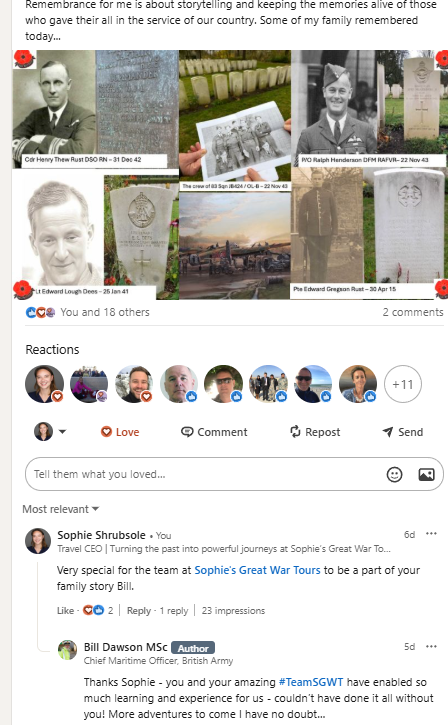
One recent journey reminded me exactly why we do what we do. Bill and his family joined us to follow in the footsteps of their relatives remembered on the Western Front. What began as a tour became days of reflection, discovery, and storytelling piecing together lives lived, choices made, and legacies carried forward.

It wasn’t just history; it was family time. It was remembrance made personal.

That’s what Sophie’s Great War Tours is today. Yes, we guide people across the battlefields of the First and Second World Wars. Yes, we bring the history to life with research, expertise, and care.

But more than anything, we help people find their story.

We help families stand where their relatives once stood. We help them understand service, sacrifice, and love in a new way.
And we give them space to remember, not just the war, but the people.

The tours have grown into something I never expected, yet exactly what I hoped for: a place where history meets heart.

If you’d like to explore your own family story or simply walk the battlefields with an experienced guide and a listening ear I’d love to help you begin that journey.